Launching a new Meta ad account requires patience, structured observation, and careful interpretation of early metrics. The goal in the first days is not immediate profitability, but identifying whether the account is moving toward consistent traffic, checkouts, and purchases.
Key Takeaways
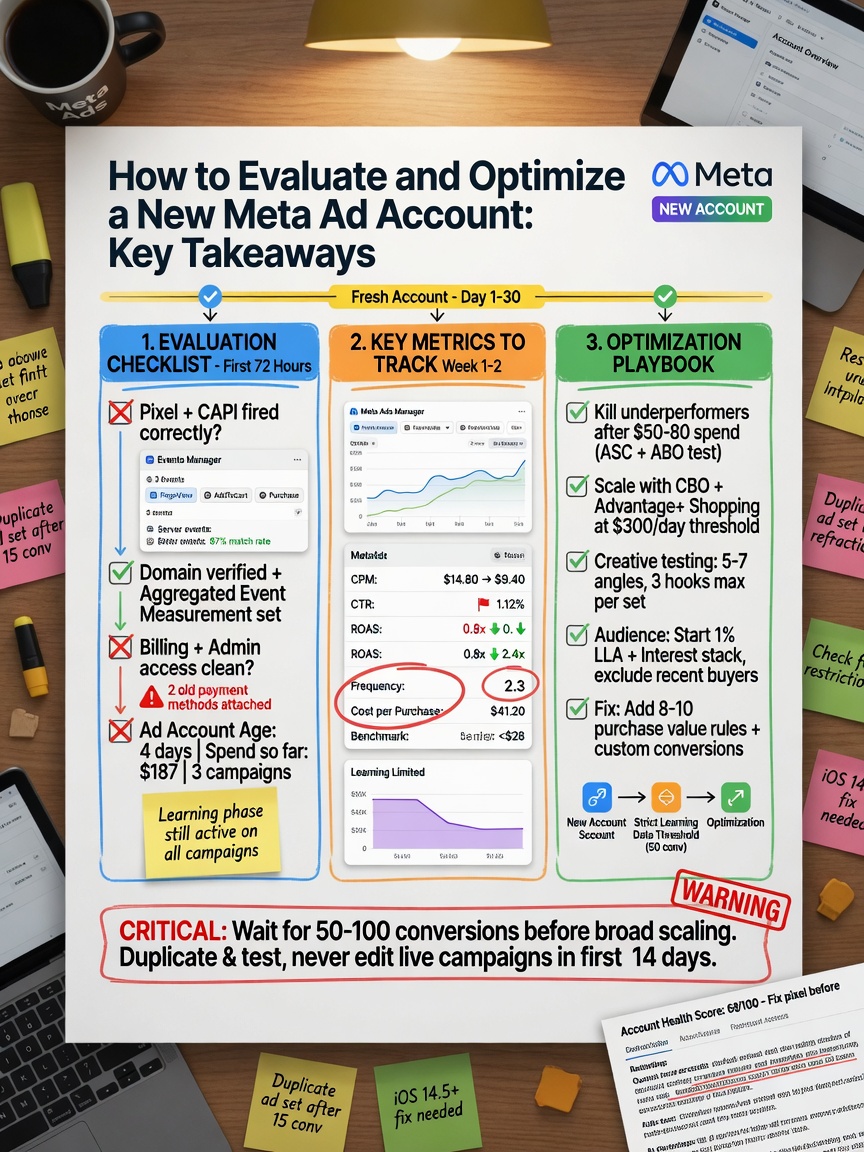
Early results are rarely profitable: A new pixel has limited data, so Meta may need time and spend to identify quality users.
Do not judge CTR in isolation: Click-through rate must be compared alongside CPM, reach, and click cost.
Consistency matters more than ROAS at the beginning: The first objective is to see signals such as link clicks, checkouts, and purchases becoming more stable.
Budget must match CPM reality: If CPMs are high, very small daily budgets may not generate enough reach to make useful decisions.
Ad-level decisions should follow the optimization event: If optimizing for purchases, prioritize ads that generate purchases over ads that only generate checkouts.
AOV can limit performance: Low average order value makes profitability harder, especially when acquisition costs are high.
How It Works
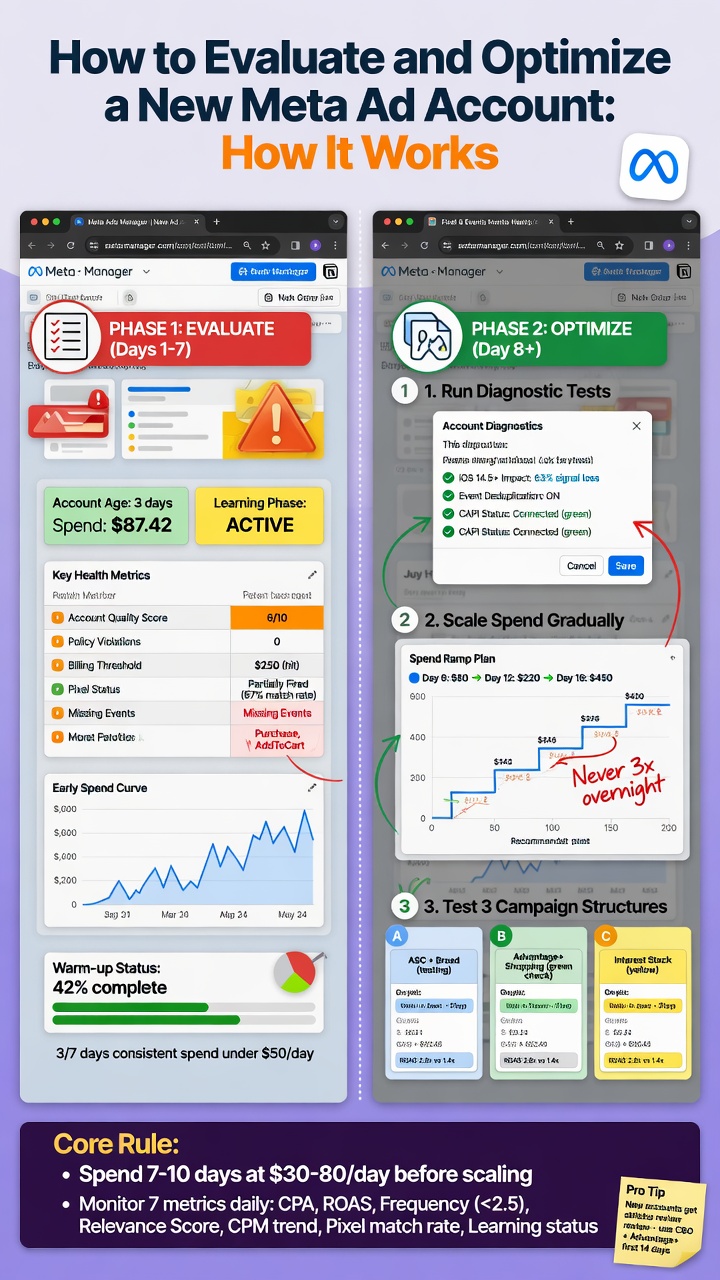
1. Start by Understanding the New Account Environment
A new Meta ad account often begins with uncertainty. The pixel has little or no historical conversion data, the algorithm does not yet know who the best buyers are, and the brand may have limited market trust. Because of this, the first few hundred dollars of spend should be treated as a learning phase rather than a scaling phase.
At this stage, the media buyer should focus on directional progress: Are users clicking? Are they reaching checkout? Are any purchases happening? Are costs improving or worsening over time? These questions are more useful than asking whether the campaign is profitable after only a few days.
2. Interpret CPM, CTR, and Cost per Click Together
CPM is the cost to reach 1,000 impressions. In a new account, CPMs can be high because Meta is testing audiences and trying to find users likely to convert. A rising CPM is not automatically bad; it may indicate that the system is moving toward higher-quality traffic.
CTR, or click-through rate, should never be analyzed alone. A 3% CTR at a very high CPM may still produce expensive clicks, while a lower CTR at a much lower CPM may generate more traffic for the same budget. For example, reaching 100 people with a high CPM and getting 3 clicks is very different from reaching 1,000 people at a lower CPM and getting 30 clicks.
The correct approach is to compare CTR only when CPM is similar. If CPM doubles, a higher CTR may not actually mean better performance. Always review CPM, reach, CTR, cost per unique link click, checkouts, and purchases together.
3. Look for Progress Before Profitability
In the first days, the account may move from zero checkouts to one checkout, then to the first purchases. Even if these purchases are unprofitable, they are useful signals. They show that Meta can find at least some buyers and that the funnel is capable of converting.
Early optimization is about measuring whether the account is improving. For example, if cost per unique link click decreases while purchases begin to appear, that may be a positive sign, even if ROAS is still poor. The goal is to confirm that the campaign has a path toward consistency.
In a new ad account, the first win is not profit; the first win is evidence that the system can find buyers.
4. Match Budget to the Cost of Data
If CPM is high, a very low daily budget may not provide enough traffic to make decisions. For example, if CPM is around $100 to $120, spending $40 or $50 per day may only reach a small number of people. That makes it difficult to evaluate ads, audiences, or conversion behavior.
This does not mean beginners should overspend recklessly. It means they should understand the relationship between budget and data volume. If the numbers are expensive, progress will require either more time, more budget, or better creatives and targeting to reduce costs.
5. Choose Broad or Interest Targeting Based on Signals
Starting with broad targeting can be useful because it gives Meta room to learn and find buyers. Broad targeting is often preferred when the algorithm has enough data or when early sales are coming through consistently.
However, if CPM remains very high and conversions are weak, testing interest-based audiences can be a practical next step. Interests may help reduce CPM or guide the algorithm toward a more relevant audience. The decision should be based on observed data, not personal preference.
6. Optimize Ads Based on Purchase Signals
At the ad level, budget distribution matters. Meta may spend most of the budget on one ad, even if another ad is producing purchases. If the campaign is optimized for purchases, the ad that gets purchases deserves attention, even if another ad has more checkouts.
In early-stage accounts, be stricter with ads that consume budget without producing the desired event. If one ad is taking most of the spend but not generating purchases, consider pausing it to give other ads room to collect data.
Practical Tips
Track daily movement: Review CPM, reach, CTR, cost per unique link click, checkouts, purchases, and ROAS every day during the early phase.
Compare fairly: Only compare CTR performance when CPM levels are similar, otherwise the conclusion may be misleading.
Prioritize purchase data: If optimizing for purchases, do not overvalue add-to-cart or checkout events when purchase signals exist.
Watch AOV: If customers are buying low-priced items instead of bundles, profitability may require better offers, upsells, or trust-building.
Use enough budget to learn: Make sure daily spend is realistic relative to CPM and expected conversion rate.
Be patient but not passive: Give the account time to learn, but actively remove ads that absorb budget without meaningful results.
Common Mistakes to Avoid
Judging a new account too quickly: Early unprofitability does not always mean the campaign is failing.
Celebrating CTR without checking CPM: A higher CTR can be misleading if impressions have become much more expensive.
Running too small a budget for high CPMs: Low spend may prevent the account from reaching enough users to generate useful data.
Optimizing for the wrong event: If the goal is purchases, do not keep an ad alive only because it generated checkouts.
Ignoring brand trust and AOV: New brands may struggle because customers do not yet trust them, leading to smaller orders and weaker ROAS.
Hiring too early without enough data: Very small businesses may be better off learning the basics themselves before paying a media buyer, so more money can go toward testing and data collection.