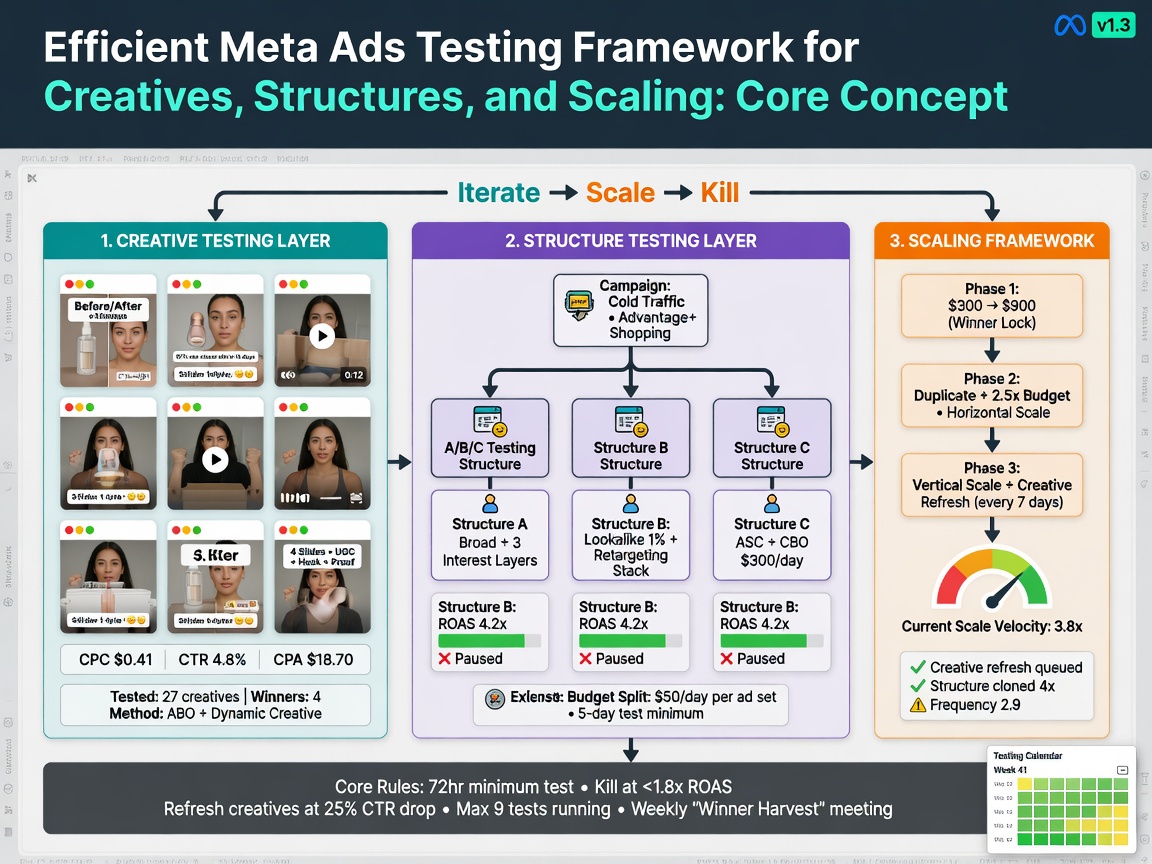
Efficient Meta Ads testing is not about copying a universal campaign structure. It is about identifying what already works inside a specific ad account, then using that proven structure to test new creatives, angles, products, or ideas with as few variables as possible.
Test with what works in your account, not with what worked in someone else’s account.
Key Takeaways
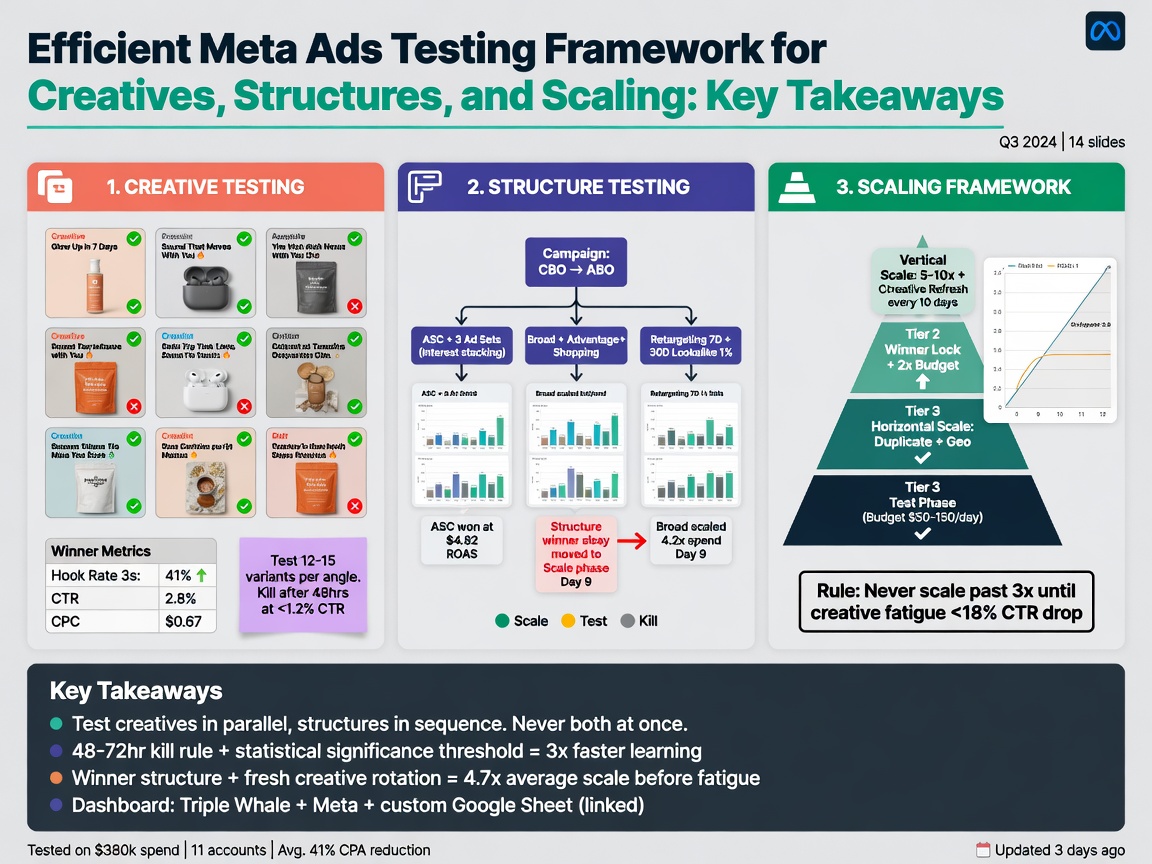
There is no single best testing structure for every Meta ad account. CBO, ABO, broad targeting, multiple ad sets, or single ad set structures can all work depending on the account.
Find the account’s working blueprint by testing different campaign structures first, then repeat the structures that consistently produce results.
Change only one major variable at a time. If the structure is proven, use it to test new creatives or angles. If the creative is proven, use it to test new structures.
Give tests enough time. A 48-hour minimum is a strong rule of thumb before making major decisions, unless something is clearly broken.
Winning ads require both volume and performance. High ROAS on tiny spend is not enough; the ad must spend meaningfully and generate acceptable results.
Scaling depends on margin above your target. Do not scale simply because a campaign is profitable; scale when performance is clearly stronger than your normal benchmark.
How It Works
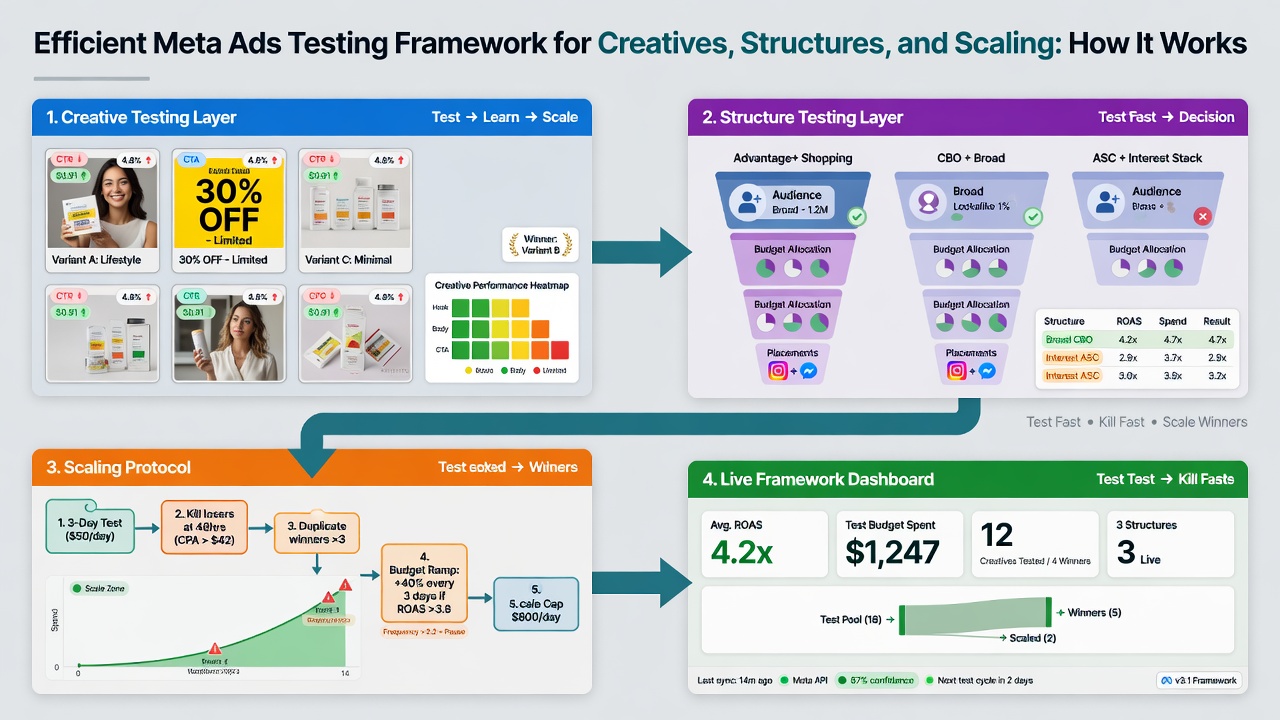
1. Build a Testing Blueprint for the Account
Start by testing multiple campaign structures to understand how the specific ad account responds. For example, one account may perform well with a CBO campaign using several ad sets, while another may perform better with an ABO campaign containing multiple ads inside a single ad set.
The goal is not to prove that one structure is universally superior. The goal is to discover the structure that Meta’s algorithm, the audience, the funnel, and the business economics seem to support in that specific account.
2. Use Proven Structures to Test New Ideas
Once a structure has worked, use it as the foundation for future testing. For example, if a CBO campaign with broad ad sets has repeatedly produced strong results, launch new campaigns using that same structure when testing new creatives or angles.
This reduces uncertainty. If a new creative fails inside a proven campaign format, the issue is more likely to be the creative, offer, angle, or message rather than the structure itself.
3. Use Proven Creatives to Test New Structures
The reverse also applies. If you already have creatives that have performed well in the ad account, they can be used to test new structures. If the creatives are known winners but fail inside a new setup, the structure may be the problem.
This approach creates cleaner tests because it isolates the variable being evaluated. Either you are testing the creative while keeping the structure stable, or testing the structure while keeping the creative stable.
4. Let Tests Run Long Enough Before Judging
A practical minimum testing period is 48 hours. This gives Meta enough time to distribute spend, collect signals, and show early performance patterns. After 48 hours, evaluate whether the campaign should be optimized, left alone, scaled, or turned off.
There are exceptions. If a campaign behaves abnormally in the first 24 hours, it may need intervention. Examples include spending far beyond the intended budget, producing unusually high click costs compared with account benchmarks, or showing signs that something is technically wrong with the pixel, funnel, or tracking.
5. Evaluate Winners by Spend, Sales Volume, and Business Metrics
A winning ad or ad set must show meaningful spend, enough conversions, and acceptable business performance. ROAS alone is not enough. A small ad that spends very little and shows a high ROAS may simply be benefiting from leftover budget and luck.
For example, if a campaign spends $800 in seven days and one ad spends only $50 but shows a very high ROAS, that does not necessarily mean it is the best ad. The real test is whether it can maintain performance when it receives a larger share of budget.
Different businesses have different acceptable targets. A SaaS company, subscription brand, ecommerce store, or digital product business may each have different break-even ROAS levels based on margins, lifetime value, and profitability.
6. Scale Only When Performance Justifies It
Not every profitable campaign should be scaled. If the target ROAS is 2.0 and a campaign is producing 2.1 or 2.2, it may be better to maintain it rather than increase budget aggressively. If the same campaign is producing 3.5 or 4.0 ROAS against a 2.0 target, it has more room to scale.
Scaling is not only about increasing budgets. It also includes maintaining stable winners, launching additional campaigns with new angles, and downscaling when performance declines.
Practical Tips
Document which structures work in each ad account, including campaign type, number of ad sets, targeting, budget level, and creative setup.
Run structured tests where only one key element changes at a time: creative, angle, offer, product, audience, or campaign structure.
Use a 48-hour decision window before judging most tests, especially if the budget and delivery look normal.
Compare results to your own benchmarks, such as typical cost per click, cost per purchase, conversion rate, ROAS, and daily profit.
Look for dominant ads or ad sets that receive a meaningful share of spend while maintaining profitable results.
Scale gradually when there is clear upside, and be prepared to reduce budgets if performance weakens.
Common Mistakes to Avoid
Copying another account’s structure blindly. What works in one ad account may fail in another because the data, funnel, offer, and audience behavior are different.
Changing too many variables at once. If creative, structure, budget, and targeting all change together, it becomes difficult to know what caused the result.
Turning off tests too early. Shutting down a campaign after only a few hours with no sales often leads to wasted spend across many incomplete tests.
Trusting high ROAS on tiny spend. Small spend can create misleading numbers. Winners need both volume and profitability.
Scaling campaigns too close to break-even. If results are only slightly above the target, aggressive budget increases can quickly destroy profitability.
Ignoring maintenance and downscaling. Sustainable Meta Ads management requires knowing when to hold, optimize, scale, or reduce budgets.